X Float · Edge-vision instrument
A froth camera trained on your cell
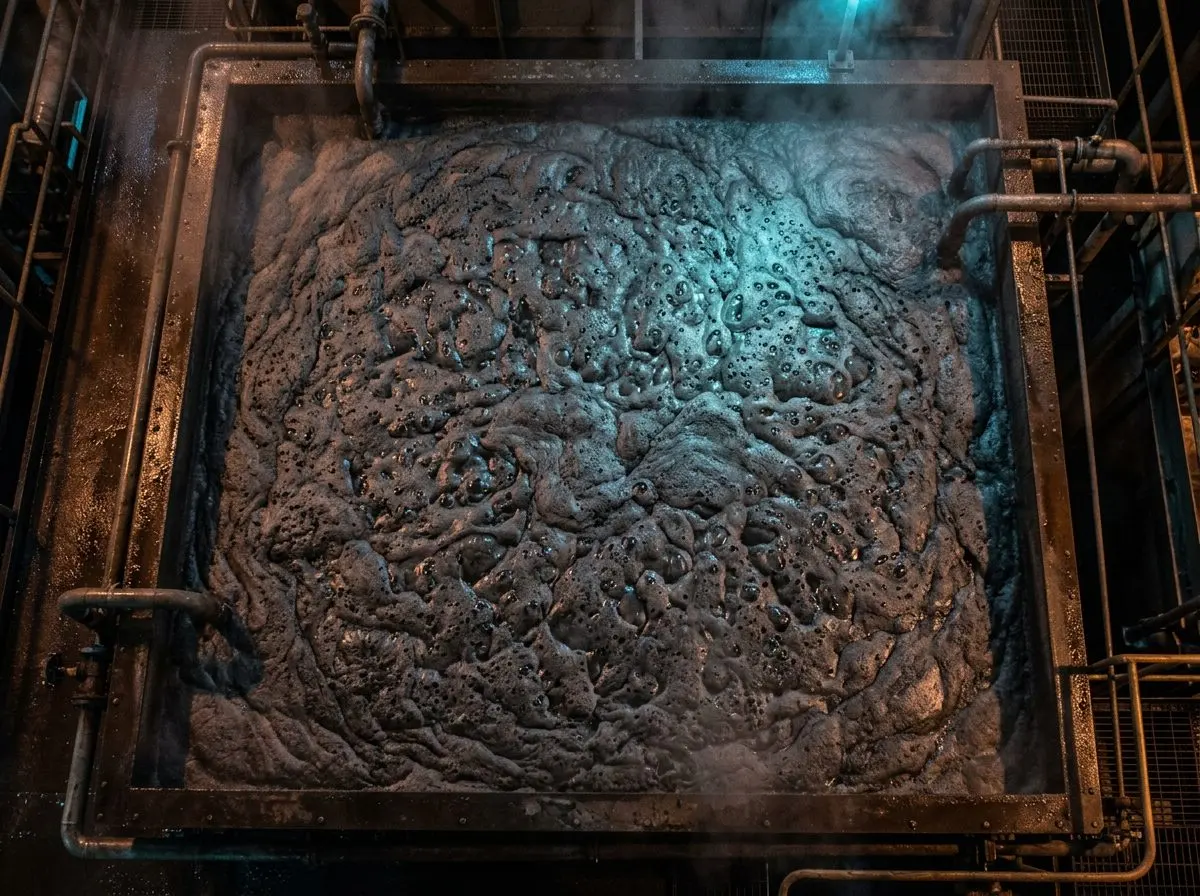
X Float measures the froth on a flotation cell, more than a dozen numbers, and writes them to Modbus registers your control system reads. The model is fitted to the cell it looks at. It goes up in an afternoon, with no shutdown.
See how it works →Trained on your cell
The model is trained on your cell, not shipped with the box
Most froth cameras turn up with the model already trained. It learned on somebody else’s cell and somebody else’s ore, and then it gets pointed at yours. That holds until your circuit does something the training set never saw.
X Float goes up over your launder and the model is fitted to that surface and to the way your froth behaves when the feed changes. Move it to another cell and it’s fitted again for that one. That is what the commissioning hours are for.
If the number you want has never been measured before, that’s the job we want. The request doesn’t join a roadmap behind forty other plants. It gets built, or we tell you it can’t be.
What it measures
More than a dozen measurements, continuously
Each one is written to a Modbus holding register, continuously. The control system reads them like any other instrument.
- Bubble size
- The size of the bubbles carrying your concentrate.
- Froth velocity
- How fast the froth is moving, and which way.
- Stability
- How long the froth holds before it collapses.
- Texture
- The coarseness and structure of the surface.
- Depth
- The froth as a surface with depth, rather than a flat picture of one.
- Colour
- One input among many.
- Process state
- The froth classified into the operating regimes the metallurgist already names.
- Dosing guidance
- Site-calibrated reagent advice for the operator to act on.
cam → edge → register → plc
How the number reaches your control room
- 1 cam · FIELD OF VIEW
Camera
A fixed camera looks down at the froth on the cell. No sampling rig, and no shutdown to install it.
- 2 edge · INFERENCE
On-device inference
The froth is measured on the device, at the plant. Nothing is uploaded and nothing waits on a server.
- 3 register · WRITE
Modbus registers
Every froth measurement is written to Modbus TCP holding registers, continuously.
- 4 plc · READ
Your PLC / DCS
The control system reads one more register and decides what to do with it.
No cloud. No GPU rack.
Datasheet
What a controls engineer needs to scope it
| Measures | Over a dozen physical froth characteristics, plus process state |
|---|---|
| Output | Modbus TCP holding registers (4–20 mA optional) |
| Reading | A number you can check against the frame it came from |
| Compute | On-device at the edge, no cloud and no GPU rack |
| Network | Power and a network drop; offline-capable, nothing leaves site |
| Mounting | Self-contained camera, fixed over the launder |
| Install | Minutes to mount, hours to commission, no process shutdown |
| Relocation | Unbolts and moves to another cell; no routine maintenance |
Running in the field
In continuous operation on a tungsten concentrator
X Float has run on the rougher launder of an operating tungsten mine in Australia since early 2026. Its registers arrive in the plant PLC like any other transmitter’s, so the metallurgist reads froth numbers in the control room they already use.
Questions
Common questions
- What does X Float measure?
- The froth on a flotation cell, turned into continuous numbers: how big the bubbles are, how fast the froth is moving, how stable it is, its texture and depth, and which operating regime the cell is in. All of it is written to Modbus registers as it is measured.
- Is the model trained on my cell?
- Yes. Commissioning fits it to your froth under your lighting, and if the camera moves to another cell it is fitted again there. It doesn’t ship with a model trained somewhere else and left as-is.
- Does X Float use AI?
- Yes, where it earns its place. Most of what X Float reports is measured from the picture, so a metallurgist who asks why a number moved gets an answer rather than a shrug. Where learning is used it is trained on your own cell, and the site-calibrated parts are fitted against your own assays. How the measurement is built is in the specification your integrator gets.
- Does it predict grade?
- Not out of the box. It reports froth metrics and process state directly. Where a site has been calibrated against assays, it can correlate those metrics to grade, and that correlation is specific to the site it was built on.
- Does it need cloud connectivity?
- Not to run. Commissioning takes a few hours with one of our engineers either on site or connected remotely, to aim the camera and calibrate it against your froth. After that X Float runs on the device and can be left fully offline. Nothing leaves site.
- How is it installed?
- It is a self-contained camera that mounts over the launder in minutes and commissions in hours, with no process shutdown. It needs no routine maintenance, and it can be unbolted and moved to another cell.
Put an instrument on your hardest measurement.
Tell us which cell or tank. A trial runs on your own froth or foam before anything is committed.
X Foam The same camera-to-register path, on process and water tanks.